Master LRT Structure
The Master’s program in Aerospace Engineering at the University of Stuttgart has a standard duration of 4 semesters, during which you must earn 120 credit points (CP). 90 CP come from lectures, divided into a compulsory elective part with 24 CP and an elective part with 66 CP. For the compulsory elective part, 4 modules must be chosen from 6 modules.
The individual contents of the compulsory elective part are compiled below.
The 6 modules provide an in-depth overview of the various disciplines of aerospace engineering. In the second and third semesters, you take the specialization modules. You choose two specialization areas, from which you must take modules totaling 24 CP each. The remaining 18 CP are filled with so-called supplementary modules. Here, you can choose almost anything offered in the Aerospace Engineering Master’s program that hasn’t been taken yet (i.e., both modules from other specialization areas and additional modules from the ones you selected). Up to 6 CP of the supplementary modules may also be chosen from the catalog of subject-related key qualifications, provided they have not already been examined in your Bachelor’s degree or any other degree program.
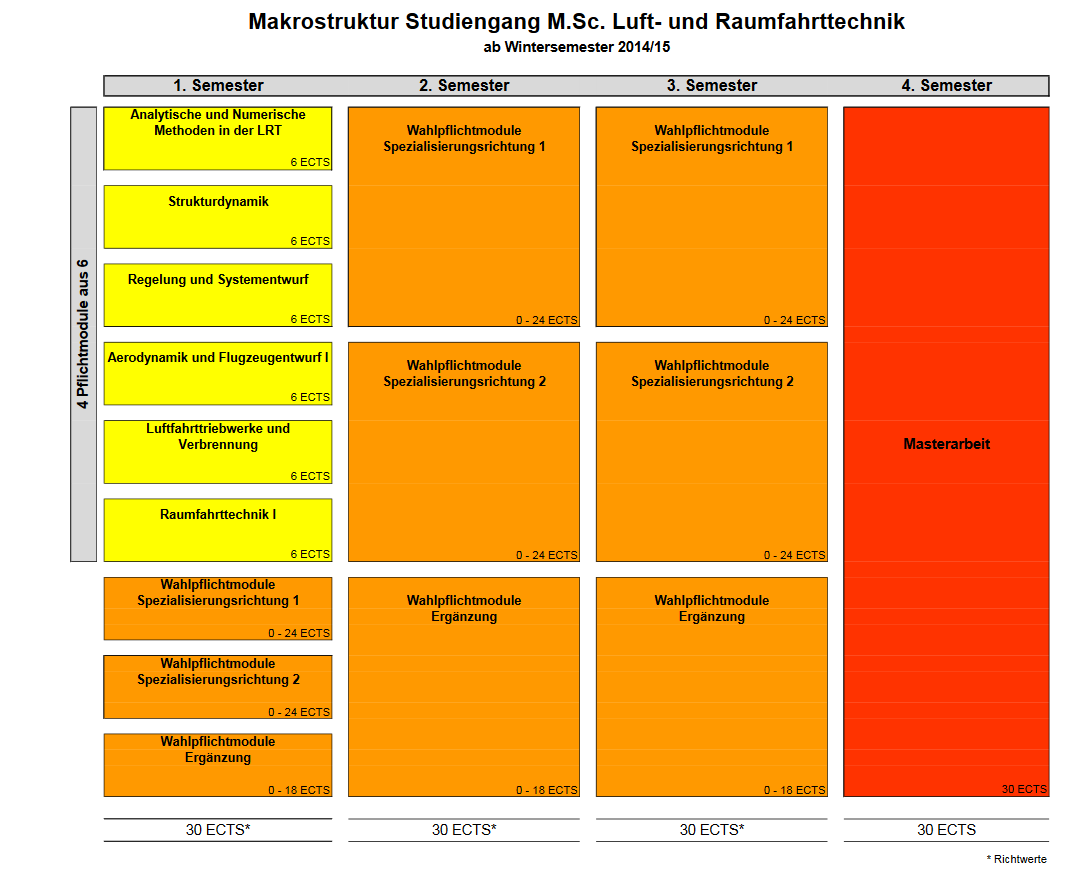
Current (binding) examination regulations and module handbooks, as well as the macrostructures, can be found on the program website.
Compulsory Elective Modules
Module: Aircraft Design and Aerodynamics
Aircraft Design:
Presentation of statistical and empirical methods for the preliminary design of aircraft. You learn to make initial estimates of weight, thrust, and performance using simple means, from which the detailed development of the aircraft proceeds. Economic aspects under which aircraft development takes place, as well as the advantages and disadvantages of certain configurations, such as canard arrangements of horizontal stabilizers, are also examined.
Aircraft Aerodynamics:
In these lectures, your knowledge of fluid dynamics is deepened. You deal with the simplified calculation of airfoils and wings and apply various approximation methods. The aerodynamic properties of 2D airfoils are analyzed as a function of geometric parameters for different Mach and Reynolds numbers. Furthermore, the basic principles and calculation methods of wing flow are presented.
At the end, there is a 120-minute exam composed of equal parts of the two topics.
Module: Space Technology I
Sensitized to environmental influences and properties of the atmospheres, methods for the successful interconnection and integration of subsystems are shown to you. How do fundamental design criteria of near- and remote-sensing missions influence your design? Orbital mechanics and propulsion technology are considered, as well as subsystems and space conditions. The importance and sustainability of remote sensing methods in space travel are also conveyed. Additionally, you get an overview of space law and space qualification.
Finally, you will be examined in a 60-minute written test.
Module: Control and System Design
This module provides an in-depth insight into the physical model, navigation, control, and design of dynamic systems. The lectures are held by the Institutes of Navigation (NAV), Flight Mechanics and Control (IFR), and Aircraft Systems (ILS).
Control:
The single-variable systems known from Control Engineering I are extended to multi-variable systems. Not only the analysis and evaluation of system properties but also controller design are covered.
System Design:
The two previous disciplines are now combined under safety aspects, and a fly-by-wire system is designed at the computer, sensor, and actuator level.
At the end of the module, there is a 120-minute written exam composed of equal parts of the three topics.
Module: Analytical & Numerical Methods in A & E
Within this module, various numerical and analytical methods for solving the characteristic differential equations in aerospace engineering are covered. For certain special cases in fluid and thermodynamics, it is possible to obtain exact analytical solutions using dimensionless considerations. However, for most problems, numerical methods must be found to solve the Navier-Stokes or transport equations. In addition to the lectures, exercises and voluntary tutorials are offered. Responsible for this module are the IAG and the ITLR.
At the end, there is a 120-minute exam composed of equal parts of the two topics.
Module: Aircraft Engines and Combustion
<Turbojet Engines:
Here, the knowledge of turbojet engines from the Bachelor’s lecture on Aerospace Propulsion is deepened. Similarity parameters for characterizing engines are introduced. This allows characteristic maps to be created for the engine components (compressor, turbine, etc.), describing the operating behavior of the components and their interaction (steady-state and transient).
Introduction to Combustion:
This lecture covers the fundamental principles of combustion processes and the associated pollutant formation. The focus is on examining reaction equations in terms of energy yield, reaction rate, and exhaust gas composition.
At the end, there is a 120-minute exam composed of equal parts of the two topics.
Module: Structural Dynamics
The knowledge already acquired in statics, engineering mechanics, and higher mathematics is expanded. Subsequently, you are able to express the motions of single and multi-body systems in mathematical form. You learn to set up the corresponding equations and calculate the vibrations in the system. For example, you can design shock absorber systems or determine how the different stages of a vibrating rocket move relative to each other. Additionally, you learn to set up and apply the finite element models commonly used today.
At the end of the module, a written exam takes place.
Specialization Areas
Here are the nine specialization areas, from which you must choose two. To get an overview of the areas, it is worth reading the descriptions in the module handbook on the program website.
| Specialization Area | Responsible Person | |
|---|---|---|
| A | Mathematical and Physical Modeling in Aerospace Engineering | Prof. Dr.-Ing. Bernhard Weigand, ITLR |
| B | Experimental and Numerical Simulation Methods in Aerospace Engineering | Prof. Dr.-Ing. Andrea Beck, IAG |
| C | Information Technology in Aerospace Engineering | PD Dr.-Ing. Stephan Rudolph, IFB |
| D | Materials, Substances, and Manufacturing Techniques in Aerospace Engineering | Prof. Dr.-Ing. Peter Middendorf, IFB |
| E | Flight Guidance and Systems Engineering in Aerospace Engineering | Prof. Dr.-Ing. Walter Fichter, IFR |
| F | Design, Layout, and Construction of Aircraft and Spacecraft | Prof. Dr.-Ing. Andreas Strohmayer, IFB |
| G | Propulsion and Energy Systems in Aerospace Engineering | Prof. Dr.-Ing. Stefan Staudacher, ILA |
| H | Space Technology and Space Utilization | Prof. Dr.-Ing. Stefanos Fasoulas, IRS |
| I | Artificial Intelligence in Aerospace Engineering | Prof. Dr.-Ing. Zamira Daw, ILS |
If you still have any questions, take a look at our FAQs. Alternatively, you can contact us via info@flurus.de or by phone (0711 685-60319 or 0711 685-62319).