Structure of the Bachelor of Science LRT
The Aerospace Engineering degree program with a Bachelor of Science degree has a standard period of study of 6 semesters. This includes a 12-week practical internship and a Bachelor’s thesis in the 6th semester. Even before the start of the program, students gain insights into manufacturing in companies during the 6-week preliminary or basic internship; the guidelines can be found here.
Due to the Corona pandemic, the standard period of study and thus the duration of eligibility for BAföG was extended for students enrolled during this time. This also affects the deadlines for the orientation examination and the “free shot” rule. For more detailed information, see the University of Stuttgart’s Exam FAQ.
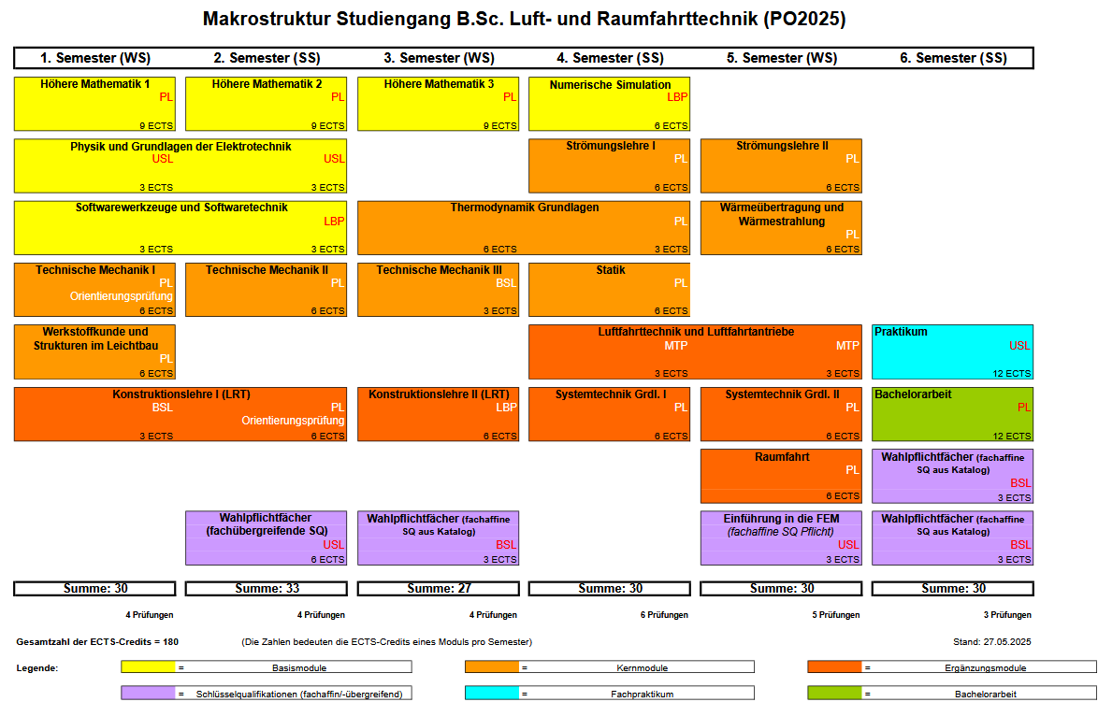
The University of Stuttgart is one of the few civilian universities that offer a German-language Aerospace Engineering bachelor’s program. This means that in addition to fundamental engineering modules such as Higher Mathematics or Engineering Mechanics, aerospace-oriented modules like Aeronautical Engineering or Spaceflight are already an integral part of the bachelor’s program. Furthermore, interdisciplinary and subject-specific key qualifications (elective modules) provide the opportunity to work on your own soft skills and pursue personal interests.
1st Semester
At the beginning of the bachelor’s program, you take the foundational modules Higher Mathematics I and Experimental Physics together with students from most other engineering programs. In Technical Drawing for Representation Technology, you not only gain your first engineering experience in CAD but also get to know your time management (when you finish at four in the morning). Additionally, the first orientation examination, which must be passed by the start of the fourth semester, is scheduled in Engineering Mechanics.
2nd-3rd Semester
In the second and third semesters, you continue to focus mainly on the fundamentals. Highlights include the Physics Lab with various experiments in the second semester and the Design Project (KON) in the third semester. In the KON, you design an aircraft component yourself and calculate its strength.
4th-5th Semester
In the fourth and fifth semesters, additional fundamentals such as Thermodynamics, Heat and Fluid Mechanics are introduced, which are already very specifically geared toward aerospace. Fluid Mechanics, for example, deals with the physical explanation of lift or explains how supersonic flows can be calculated. In Numerical Simulation, computer-aided solution approaches for engineering problems are examined.
For aviation enthusiasts, there is a lot from the 4th semester onwards: in Systems Engineering, Aircraft Systems, Aeronautical Engineering, and Aircraft Propulsion, you learn (almost) everything about flying in an aircraft, the technology, and the mathematics behind it.
In the fifth semester, those interested in spaceflight also get their money’s worth with the Spaceflight lecture. This covers many aspects, such as rocket engines, interplanetary flights, and satellite design.
6th Semester
The sixth semester is kept free of lectures so that you can fully concentrate on the practical internship and the Bachelor’s thesis. This is also a good time to plan a stay abroad. The internship and Bachelor’s thesis can be completed at your choice in industry or at the university. Often, the internship is (voluntarily) extended from the mandatory 12 weeks to 6 months, and the Bachelor’s thesis is postponed to a seventh semester.
Key Qualifications
There is a wide selection of elective courses. Here, students can choose from a large number of courses. As a subject-specific key qualification (from the faculty’s program), you can, for example, fly in a small aircraft as part of the Flight Lab and take measurements or participate in a real research project as part of a project work. As an interdisciplinary key qualification, you can take a wide variety of courses from the Studium Generale of the University of Stuttgart, including many language courses and personal development opportunities.
The overview diagram shows the subject breakdown for each semester. You can find all documents on the program homepage.
Typically, a master’s program follows the bachelor’s degree. This can be continued in Stuttgart or at another university.
If you still have any questions, take a look at our FAQs. Alternatively, you can contact us via info@flurus.de or by phone (0711 685-60319 or 0711 685-62319).